.
https://fasciniodafotografia.wordpress.com/category/fotografos-e-exposicoes/


 “Emotions are not just the fuel that powers the psychological mechanism of a reasoning creature, they are parts, highly complex and messy parts, of this creature’s reasoning itself,” philosopher Martha Nussbaum wrote in her incisive treatise on the intelligence of emotions, titled after Proust’s powerful poetic image depicting the emotions as “geologic upheavals of thought.” But much of the messiness of our emotions comes from the inverse: Our thoughts, in a sense, are geologic upheavals of feeling — an immensity of our reasoning is devoted to making sense of, or rationalizing, the emotional patterns that underpin our intuitive responses to the world and therefore shape our very reality. Our interior lives unfold across landscapes that seem to belong to an alien world whose terrain is as difficult to map as it is to navigate — a world against which the young Dostoyevsky roiled in a frustrated letter on reason and emotion, and one which Antoine de Saint-Exupéry embraced so lyrically in one of the most memorable lines from The Little Prince: “It is such a secret place, the land of tears.”


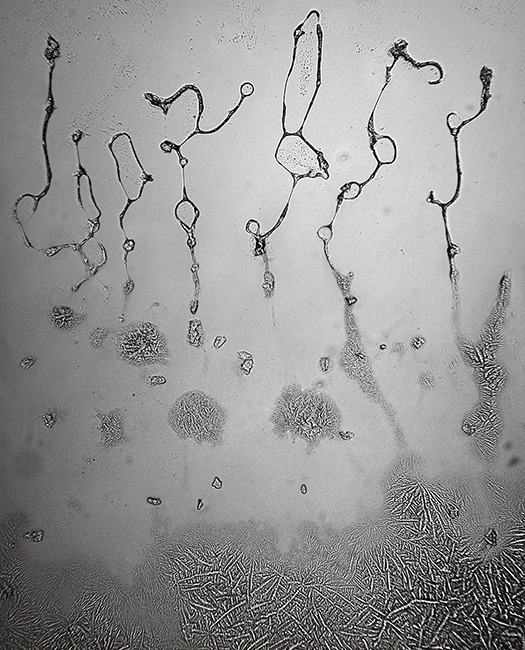
Though the empirical nature of tears is a composition of water, proteins, minerals, hormones, and enzymes, the topography of tears is a momentary landscape, transient as the fingerprint of someone in a dream. The accumulation of these images is like an ephemeral atlas.[…]Tears are the medium of our most primal language in moments as unrelenting as death, as basic as hunger, and as complex as rites of passage. They are the evidence of our inner life overflowing its boundaries, spilling over into consciousness. Tears spontaneously release us to the possibility of realignment, reunion, catharsis, intractable resistance short-circuited… It’s as though each one of our tears carries a microcosm of the collective human experience, like one drop of an ocean.


“For a tear is an intellectual thing,” the great subversive 19th-century poet William Blake wrote, railing against the Deists, classical and contemporary; he believed they had stripped religion of its signal call for forgiveness, assigning too much authority to a single God and making human life untenable in its guilty abrasions. Tears are intellectual because they come from thoughts that spill over the body’s containing well; they are the secretion of excess we assign to emotion; perhaps emotion itself is simply caused by a surfeit of thought. One tries to unbind these durable dualities, to allow for the morphological shift that might allow the human creature to be complex but integrated, not divided into anatomical parts, all nouns and no transitive verb. We are not yet mechanical, technological things, we are intellectual — thinking — beings, and we cry when stirred beyond the capture of signifying Logos, which relents into flows of passionate silence. Perhaps this flow is the very proof that we cannot put our feelings in one place and our thoughts in another, the bleak result of a certain rationalism that threatens to overtake our civility — our capacity to forgive — and wants to make all ideas into abstractions, rigid and blunt, free of secretions.